Maternity and Parental Leave Calculator: How to Count Leave Dates
A maternity and parental leave calculator is useful for organizing dates, but it cannot decide every legal or workplace question. You need to separate maternity leave before birth, the post-birth protected period, parental leave, and birth-related leave for fathers. Then compare the expected due date, actual birth date, the child’s age, employer procedures, and any extension conditions. This guide explains the date logic in plain language, gives worked examples, and shows how to use the site’s calculator as a reference rather than as an eligibility decision.

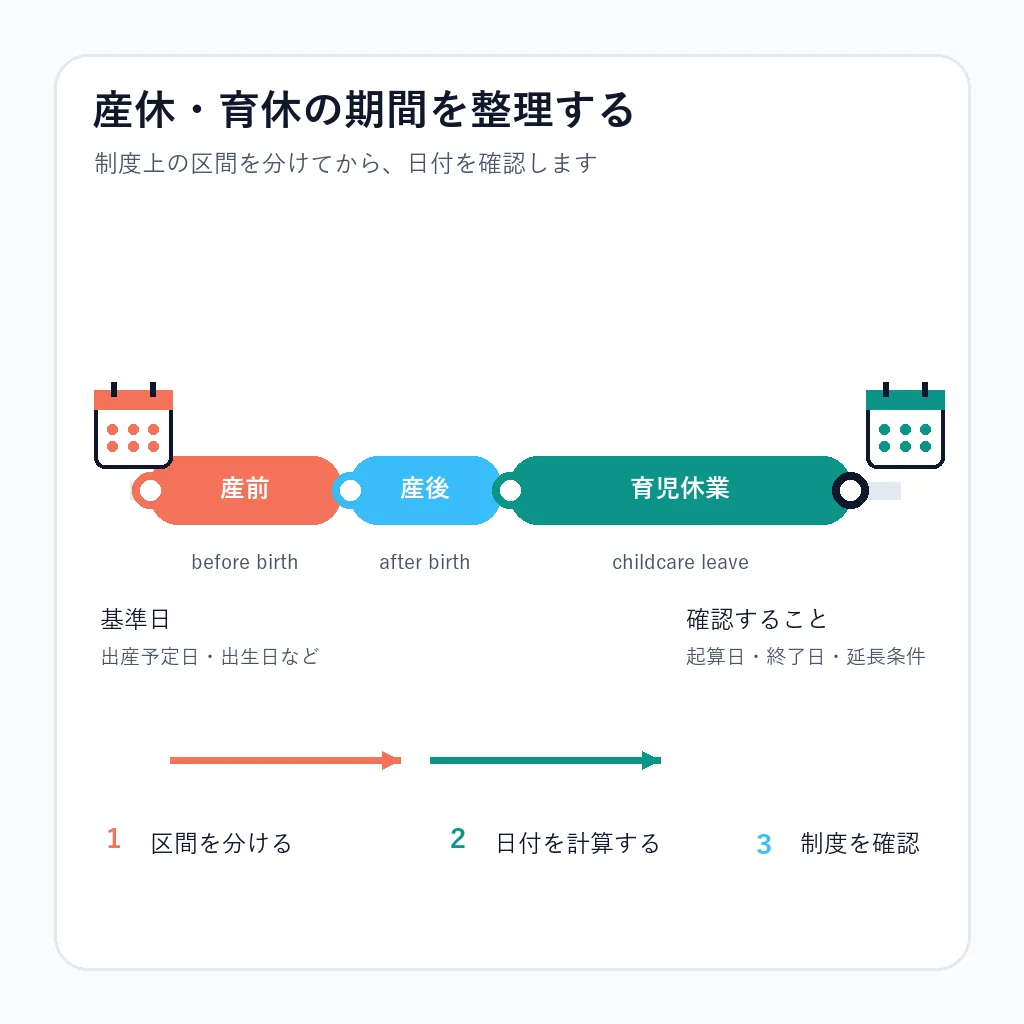
The short answer: Separate the period before birth, the eight-week period after birth, and parental leave. A single date formula is not enough because the expected due date and the actual birth date play different roles. Use the calculator to organize calendar dates, then confirm eligibility, notice deadlines, extensions, and benefits with your employer and official Ministry of Health, Labour and Welfare information.
The basic way to separate maternity and parental leave dates
People searching for a maternity and parental leave calculator usually need the start date, the transition to the next leave type, and the date to place on an employer form—not only a total. Put pre-birth leave, the post-birth period, parental leave, and any birth-related leave for the father on separate calendar lines.
| Period | General reference | What the date check should show |
|---|---|---|
| Maternity leave before birth | Six weeks before the expected date; fourteen weeks for a multiple pregnancy | The date counted backward from the expected date and the end at birth |
| Post-birth protected period | Eight weeks after the birth as the basic reference | The period based on the actual birth date |
| Parental leave | A childcare period checked against the child’s age | The start date, the first age-based end point, and possible extension |
| Birth-related leave for fathers | A separate period within the early weeks after birth | The requested dates, notice deadline, and the specific leave type |
Maternity leave, post-birth leave, and parental leave are different
In everyday English, “maternity leave” may describe time away from work around childbirth. Japanese employment materials distinguish the pre-birth, post-birth, and childcare-leave periods. Treating them as one block can shift the calendar.
How to count the six-week and eight-week periods
Count backward from the expected date for the pre-birth reference: six weeks (42 calendar days) for a single pregnancy and fourteen weeks (98 days) for a multiple pregnancy. Check the result against the worker’s request, employer form, and actual birth date.
| Check | Calculation direction | Common mistake |
|---|---|---|
| Single-pregnancy pre-birth period | Count 42 days backward from the expected date | Treating the calculated date as an automatic request date |
| Multiple-pregnancy pre-birth period | Count 98 days backward from the expected date | Using the single-pregnancy six-week period |
| Post-birth period | Count the eight-week reference from the actual birth date | Keeping the original due date after the birth date changes |
| Next leave stage | Check the day after the applicable period ends | Confusing the leave date with a benefit or notice date |
Confirm whether the birth date is displayed as a date in the period or as the reference point before day one.
Do not assume that an elapsed-day result and the final date printed on a statutory form use the same display convention.
Place the calculator result beside the employer’s written schedule before copying it into an application.
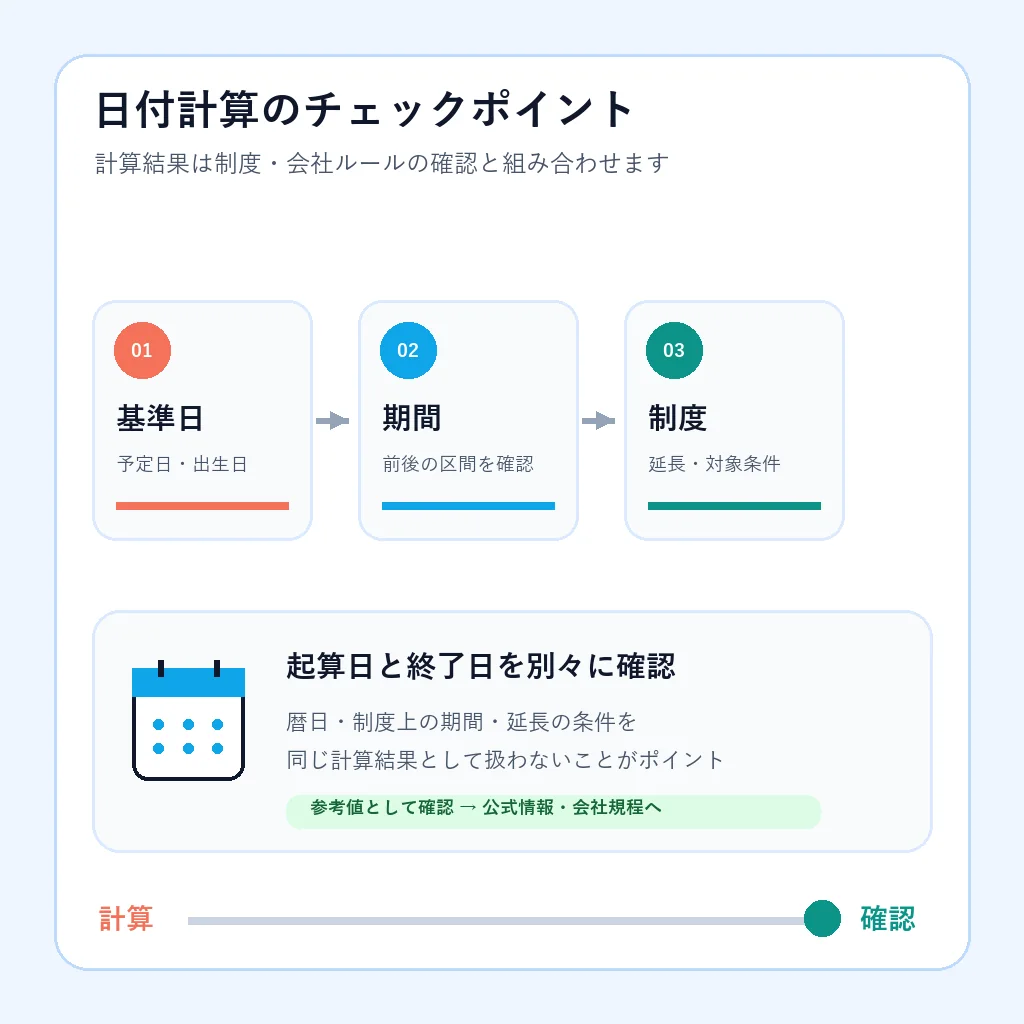
Worked examples using due and birth dates
After planning, update the calendar with the actual birth date. The table uses October 20, 2026 as the expected due date to show how the reference dates move; it is an example, not a personal legal determination.
| Scenario | Pre-birth reference | Eight-week post-birth reference | Possible next-stage date |
|---|---|---|---|
| Birth on October 20 | September 8 through October 20 | October 21 through December 15 | December 16 onward |
| Early birth on October 10 | Ends at the October 10 birth date | October 11 through December 5 | December 6 onward |
| Late birth on October 28 | Ends at the October 28 birth date | October 29 through December 23 | December 24 onward |
| Multiple pregnancy, due October 20 | Check 98 days before the expected date | Check 56 days from the actual birth | Review the childcare-leave stage separately |
How to identify parental-leave start and end dates
When the mother continues from the post-birth period, the following day is commonly checked as the parental-leave start. A father’s date depends on the chosen leave system, so label each period by name on the family calendar.
Birth-related leave for fathers is a separate check
Birth-related leave for fathers, sometimes called postpartum paternity leave, is separate from ordinary parental leave. It covers an early period after birth and has its own timing, notice, split, and work rules; do not reduce it to “eight weeks after birth.”
How to use a maternity and parental leave calculator safely
A calculator is most useful when it accepts both the expected due date and the actual birth date. On this site’s maternity and parental leave calculator, enter those dates and whether the pregnancy is multiple to organize reference dates before contacting an employer or public office.
- Expected due date: enter the date from the medical provider or document.
- Actual birth date: update the result after birth.
- Multiple pregnancy: use the fourteen-week pre-birth reference.
- Output: compare the reference dates with the employer form.
Counting an extension after the child turns one
Parental leave may be extended to one year and six months, and in some cases two years, when the requirements are met. It is not automatic: childcare availability, application timing, and required documents can affect the result.
| Date | Why it matters | What a calculator can do |
|---|---|---|
| Child’s date of birth | The basis for age-based dates | Show elapsed time and reference milestones |
| Current leave end date | The point before an extension | Place the date beside the child’s age milestones |
| Childcare application and result | May relate to extension conditions and timing | Keep the dates together on a planning calendar |
| Employer notice deadline | A procedure deadline separate from the leave period | Count the remaining calendar days to prepare |
Parental-leave benefits and insurance are separate checks
Leave length and the period eligible for parental-leave benefits are not automatically the same. Benefits can depend on insurance coverage, work records, work during leave, wages, and a separate application, so a date calculation cannot guarantee payment.
It can: organize due dates, birth dates, calendar periods, and possible transition dates.
It cannot: decide eligibility, notice compliance, extension approval, benefit amounts, or insurance treatment.
Do not use the tool output alone to submit an application or promise a payment.
A checklist before submitting a request
After organizing the dates, put the due date and actual birth date on one calendar and label which date controls each period. Record the leave type beside every start and end date instead of keeping only a total-day number.
- The due date and actual birth date are confirmed.
- Single or multiple pregnancy is confirmed.
- Each leave type has its own line.
- The start/end convention matches the employer form.
- The notice deadline and documents are confirmed.
- Extension requirements were checked if relevant.
- Benefit and insurance questions went to the right contact.
- Unclear points were checked against official guidance.
Check reference dates from the due date and birth date
Use the tool to place reference dates on a calendar, then confirm them with your employer and official guidance.
Open the maternity and parental leave calculator →Official references
Use these Ministry materials with the employer’s current form and instructions.
- MHLW Maternal Health Management Information — General information about maternity protection and leave around childbirth
- MHLW: Outline of the Child Care and Family Care Leave Act — Reference for parental-leave systems and extensions
- MHLW: Birth-related leave for fathers — Reference for the early post-birth leave system
- MHLW: Parental-leave benefits and application procedures — Keep benefit rules separate from calendar dates
Official links checked September 13, 2026. If a source is revised, use the latest version published by the Ministry.
Maternity and parental leave calculator FAQ
How many days is maternity leave in Japan?
The common reference is six weeks before the expected due date, or fourteen weeks for a multiple pregnancy, plus an eight-week post-birth period. The exact handling also depends on the worker’s request, the actual birth date, and the employer’s procedure, so a total-day number should not be treated as a final legal decision.
Can I calculate maternity and parental leave dates from the due date alone?
You can calculate a planning reference for the pre-birth period from the due date, but the post-birth period uses the actual birth date. Update the calendar after birth, especially if the baby arrives early or late, and compare the result with the employer’s written schedule.
How do I count the eight weeks after birth?
Use the actual birth date as the reference and check the eight-week period on the employer’s form. Calendar examples may count from the following day as day one, but display conventions can differ, so confirm the final end date before submitting a request.
When does parental leave start?
For a mother who continues from the post-birth period, parental leave is commonly checked from the day after that period ends. A father’s start date depends on the leave system selected, including standard parental leave and birth-related leave for fathers. Ask the employer to confirm the exact date.
Does parental leave end on the child’s first birthday?
The ordinary end point is checked against the child reaching one year of age, using the wording and date convention on the official form. In some circumstances an extension to one year and six months or two years may be available, but it is not automatic and has separate conditions.
Can a calculator approve my parental-leave application?
No. A calculator organizes calendar reference dates. It does not decide eligibility, notice compliance, employer agreements, extension conditions, benefit amounts, or social-insurance treatment. Confirm those points with the employer and current official guidance.